
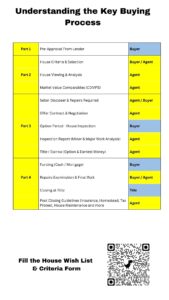
The Complete Process of Buying a House
From saving your down payment to getting the keys in your hand — everything you need to know, in the right order.
Buying a house is the largest financial decision most people will ever make. It’s also one of the most rewarding. But the process involves more steps, more people, and more paperwork than most first-timers expect. This guide walks you through every stage — in plain English — so you know exactly what’s coming.
Check Your Financial Health
Before you browse a single listing, get a clear picture of your financial situation. Lenders will scrutinize everything — your credit score, debt-to-income ratio, savings, and job history — so it pays to know where you stand first.
- Credit score: Aim for 620+ for a conventional loan, 580+ for FHA. Higher scores unlock better interest rates — even a 0.5% difference saves tens of thousands over a 30-year mortgage.
- Down payment: Conventional loans typically require 3–20%. FHA loans require 3.5%. VA and USDA loans offer 0% down for eligible buyers.
- Debt-to-income ratio (DTI): Most lenders want your total monthly debts (including your future mortgage) to be below 43% of your gross monthly income.
- Emergency fund: Beyond your down payment, have 3–6 months of expenses saved. Homeownership always comes with surprise costs.
- Employment history: Lenders prefer 2+ years of stable employment at the same employer or in the same field.
Get Pre-Approved for a Mortgage
A mortgage pre-approval is a lender’s written commitment to lend you up to a certain amount, based on a review of your finances. It’s not just helpful — in most competitive markets, sellers won’t consider an offer without one.
Pre-approval is different from pre-qualification. Pre-qualification is a quick estimate based on self-reported information. Pre-approval involves a hard credit pull and verification of your actual documents.
Find a Buyer’s Real Estate Agent
A buyer’s agent represents your interests — not the seller’s — throughout the entire transaction. They help you find homes, negotiate offers, navigate inspections, and guide you through closing. Best of all, the buyer’s agent is typically paid by the seller, so their services cost you nothing directly.
- Ask friends and family for referrals — word of mouth is the most reliable filter
- Interview at least 2–3 agents before choosing
- Look for someone with experience in your target neighborhoods and price range
- Check their recent reviews on Zillow, Google, or Realtor.com
- Confirm they are a licensed REALTOR® and member of your local MLS
Search for Homes
Now the fun part — but also the part that can drag on longest. Before you start touring homes, define your must-haves vs. nice-to-haves. You’ll rarely find a home that checks every box, so knowing your priorities in advance prevents emotional decisions.
- Location: School district, commute time, walkability, flood zone, neighborhood safety
- Size: Bedrooms, bathrooms, square footage, garage, yard
- Condition: Move-in ready vs. fixer-upper — how much renovation are you willing to take on?
- Budget: Stay below your maximum pre-approval amount — leave room for bidding, repairs, and life
Use Zillow, Redfin, and Realtor.com to browse online, but rely on your agent for MLS access — some listings hit the MLS before they appear on public sites.
Make an Offer
When you find the right home, your agent will help you write a purchase offer — a formal legal document that includes your proposed price, contingencies, and timeline. The seller can accept, reject, or counter your offer.
- Offer price: Based on comparable recent sales (comps) in the neighborhood, not the asking price
- Earnest money deposit: Typically 1–3% of the purchase price, paid upfront to show you’re serious. It’s applied toward closing costs if the deal proceeds.
- Contingencies: Conditions that must be met for the sale to proceed — most common are inspection, financing, and appraisal contingencies
- Closing date: Usually 30–60 days after offer acceptance
- Inclusions: Specify what stays with the home — appliances, fixtures, window treatments
Get a Home Inspection
Once your offer is accepted, schedule a professional home inspection immediately — you typically have 7–10 days. An inspector will examine the home’s structure, systems, and components and provide a detailed written report.
- Roof, gutters, and exterior
- Foundation and structure
- Plumbing and water heater
- Electrical panel and wiring
- HVAC systems (heating & cooling)
- Windows, doors, and insulation
- Attic and crawl space
After the inspection, you can request repairs, ask for a price reduction, or — if issues are serious enough — walk away entirely (if your inspection contingency is in place).
Finalize Your Mortgage
With your offer accepted, it’s time to formally apply for your mortgage (your pre-approval was just the first step). Your lender will begin the underwriting process — verifying all your financial information and assessing the risk of lending to you.
- Submit your full mortgage application with updated documents
- Lock in your interest rate (protect against rate increases before closing)
- Respond quickly to any requests from your underwriter — delays here push back your closing date
- Avoid major financial changes: don’t open new credit accounts, change jobs, or make large purchases during underwriting
Common loan types:
The Home Appraisal
Your lender will order an independent appraisal to confirm the home’s market value before approving your loan. The appraiser visits the property and compares it to recent nearby sales to determine what it’s worth.
- If the appraisal comes in at or above your offer price: Great — your loan proceeds as planned.
- If the appraisal comes in low: You have options — renegotiate the price with the seller, pay the difference in cash, or walk away if your appraisal contingency allows it.
Conduct the Final Walk-Through
The final walk-through usually happens 24–48 hours before closing. This is your last chance to verify the home is in the agreed-upon condition before you sign anything.
- All agreed-upon repairs have been completed
- All appliances and fixtures included in the sale are still present and working
- No new damage has occurred since your inspection
- The home has been cleaned and the seller’s belongings removed
- All keys, garage openers, and access codes are ready to be handed over
Close on Your Home
Closing day is when ownership officially transfers from seller to buyer. You’ll sign a mountain of documents, pay your closing costs, and walk away with the keys. Plan for 1–3 hours at the closing table.
- Bring a government-issued photo ID
- Bring a cashier’s check or arrange a wire transfer for your closing costs and down payment
- Review the Closing Disclosure (sent 3 days before closing) — it itemizes every fee
- Sign the mortgage note, deed of trust, and closing disclosure
- The title company records the deed with the county
- You receive the keys 🔑
Typical closing costs breakdown:
| Cost Item | Typical Amount | Who Pays |
|---|---|---|
| Loan origination fee | 0.5–1% of loan | Buyer |
| Appraisal fee | $300–$600 | Buyer |
| Title insurance | $500–$2000 | Buyer (lender’s policy) |
| Homeowner’s insurance (1st year) | $800–$2,000 | Buyer |
| Property taxes (prepaid) | 2–6 months prepaid | Buyer |
| Attorney / escrow fee | $500–$1,500 | Split or buyer |
| Recording fees | $50–$250 | Buyer |
| Total Closing Costs | 3–5% of home price | Primarily Buyer |
By Salim Rajani, Realtor
www.rajanisalim.com